The Real Number System
Exercise Set 2
| In exercises 1 and 2, graph each number on a real number line | |
| 1. `-4`; `-2`; `7/4`; `2.5` | 2. `-3.5`; `0`; `3`; `9/4` |
| In exercises 3 to 14, replace the `square` with the appropriate symbol (` < `, `=`, or ` > `). | |||
| 3. `5/2 square 4` | 4. `-3/2 square -3` | 5. `2/3 square 0.6666` | 6. `1/5 square 0.2` |
| 7. `1.75 square 2.23` | 8. `1.25 square 1.3` | 9. `0.bar36 square 4/11` | 10. `0.4 square 4/9` |
| 11. `10/5 square 2` | 12. `0/2 square -0/5` | 13. `pi square 3.14159` | 14. `22/7 square pi` |
| In exercises 15 to 26, graph each inequality and write the inequality using interval notation. | |||
| 15. `3 < x < 5` | 16. `-2 <= x < 1` | 17. `x < 3` | 18. `x >= 4` |
| 19. `x >= 0` and `x < 3` | 20. `x > -4` and `x <= 4` | 21. `x < -3` or `x >= 2` | 22. `x <= 2` or `x > 3` |
| 23. `x > 3` and `x < 4` | 24. `x > -5` or `x < 1` | 25. `x <= 3` and `x > -1` | 26. `x < 5` and `x <= 2` |
| In exercises 27 to 38, graph each interval and write each interval as an inequality. | |||
| 27. `[-4,1]` | 28. `[-2,3)` | 29. `(1,5)` | 30. `(1,4]` |
| 31. `[2.5,oo)` | 32. `(-oo,3]` | 33. `(-oo,2)` | 34. `(pi,oo)` |
| 35. `(-oo,2]uu(3,oo)` | 36. `(-oo,1)uu(4,oo)` | 37. `(-oo,3)uu(3,oo)` | 38. `(-oo,1)uu[2,oo)` |
| In exercises 39 to 46, use the given notation or graph to supply the notation or graph that is marked with a question mark. | |||
| Inequality Notation | Interval Notation | Graph | |
| 39. | `x <= 3` | ? | ? |
| 40. | ? | `(-2,oo)` | ? |
| 41. | ? | ? | 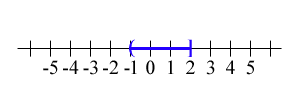 |
| 42. | `-3 <= x < -1` | ? | ? |
| 43. | ? | `[1,4]` | ? |
| 44. | ? | ? | 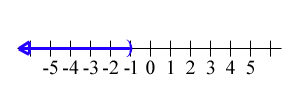 |
| 45. | ? | `[-2,pi)` | ? |
| 46. | `x < 2 \ \ \ \ \ ` or ` \ \ \ \ \ x >= 4` | ? | ? |
| In exercises 47 to 60, write each expression without absolute value symbols. | |
| 47. `|4|` | 48. `|-8|` |
| 49. `|-27.4|` | 50. `|3|-|-7|` |
| 51. `-|-3|-|8|` | 52. `|4| |-8|` |
| 53. `|y^2+10|` | 54. `|x^2+1|` |
| 55. `|-1-pi|` | 56. `|x+6|+|x-2|`, given `0 < x < 1` |
| 57. `|x-4|+|x+5|`, given `2 < x < 3` | 58. `|x+1|+|x-3|`, given `x > 5` |
| 59. `|(x+7)/(|x|+|x-1|)|`, given `0 < x < 1` | 60. `|(x+3)/(|x-1/2|+|x+1/2|)|`, given `0 < x < 0.2` |
| In exercises 61 to 72, find the distance between the points whose coordinates are given. | |||
| 61. `8,1` | 62. `-2,-7` | 63. `-3,5` | 64. `-5,8` |
| 65. `16,-34` | 66. `-108,22` | 67. `-38,-5` | 68. `pi,3` |
| 69. `-pi,3` | 70. `1/7,-1/2` | 71. `1/3,3/4` | 72. `0,-8` |
| In exercises 73 to 80, use absolute value notation to describe the given expression. | |
| 73. Distance between `a` and `2` | 74. Distance between `b` and `-7` |
| 75. `d(m,n)` | 76. `d(p,-8)` |
| 77. The distance between `a` and `4` is less than `z`. | 78. The distance between `z` and `5` is greater than `4`. |
| 79. The distance between `x` and `-2` is less than `7`. | 80. The distance between `y` and `-3` is greater than `6`. |
| In exercises 81 to 84, write interval notation for the given expression. | |
| 81. `x` is a real number and `x!=3`. | 82. `x` is a real number whose square is nonnegative. |
| 83. `x` is a real number whose absolute value is less than `3`. | 84. `x` is a real number whose absolute value is greater than `2`. |
| In exercises 85 to 87, determine whether each statement is true or false. |
| 85. `|x|` is a positive number. |
| 86. `|-y|=y` |
| 87. If `m < 0`, then `|m|=-m`. |
| 88. For any two different real numbers `x` and `y`, the smaller of the two numbers is given by Verify the statement given for |
||
| a. `x=5` and `y=8` | b. `x=-2` and `y=7` | c. `x=-4` and `y=-7` |
| 89. Prove the expression in Exercise 88 yields the smaller of the numbers `x` and `y`. Hint:Evaluate the expression for the two cases |
| 90. The inequality `|a+b| <= |a|+|b|` is called the triangle inequality. For what values of `a` and `b` does |