Subsets of real numbers can also be represented by a compact form of notation called interval notation. For example, `[-1,3)` is the interval notation for the subset of real numbers between `-1` and `3`, including `-1` but not including `3`.
In general, the interval notation
| `(a,b)` | represents all real numbers bewtween `a` and `b`, not including `a` and not including `b`. This is an open interval. Using inequalities, this is written as `a < x < b`. |
| ` [a,b]` | represents all real numbers bewtween `a` and `b`, including `a` and including `b`. This is an closed interval. Using inequalities, this is written as `a <= x <= b`. |
| `(a,b]` | represents all real numbers bewtween `a` and `b`, not including `a` but including `b`. This is an half-open interval. Using inequalities, this is written as `a < x <= b`. |
| `[a,b)` | represents all real numbers bewtween `a` and `b`, including `a` but not including `b`. This is an half-open interval. Using inequalities, this is written as `a <= x < b`. |
Subsets of the real numbers whose graphs extend forever in one or both directions can be respresented by interval notation using the infinity symbol `oo` or the negative infinity symbol `-oo`.
| `(-oo,a)` | represents all real numbers less than `a`. | 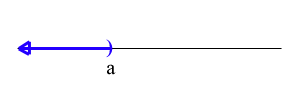 |
| ` (b,oo]` | represents all real numbers greater than `b`. | 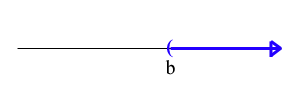 |
| `(-oo,a]` | represents all real numbers less than or equal to `a`. | 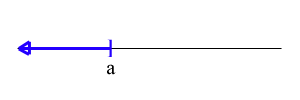 |
| `[b,oo)` | represents all real numbers greater than or equal to `b`. | 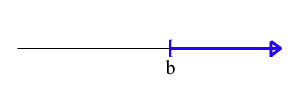 |
| `(-oo,oo)` | represents all real numbers. | 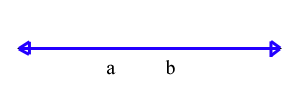 |
Some graphs consists of more than one interval of the real number line. Figure P.9 is a graph of the interval `(-oo,-2)`, along with the interval `[1,oo)`.
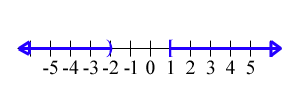
The word or is used to denote the union of two sets. The word and is used to denote intersection. Thus the graph in Figure P.9 is denoted by the inequality notation
To represent this graph using interval notatio, use the union symbol `uu` and write `(-oo,-2)uu[1,oo)`.
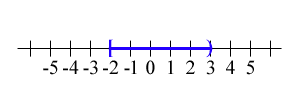
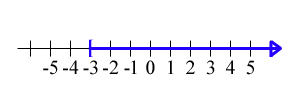
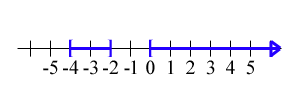
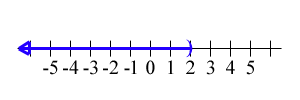
| Graph the following. Also write a. and b. using interval notation, and write c. and d. using inequality notation. | |||
| a. `-2 <= x < 3` | b. `x >= -3` | c. `[-4,-2]uu[0,oo)` | d. `(-oo,2)` |